
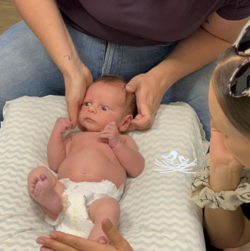
Pediatric Chiropractic in Kelowna
Pediatric Chiropractic in Kelowna – Tell me more about chiropractic care for infant patients
If you are new to the concept of offering chiropractic care to children and infants, there are probably a few questions that come up. What does body work look like on a baby? How old or big do they need to be? What safety concerns need to be considered? What does an infant’s appointment with a chiropractor actually look like? How do I know if chiropractic care is appropriate for my child?
We are here to answer questions and help you make informed healthcare decisions for your family.
Chiropractic Care for Infants – How is manual therapy modified to be appropriate for small babies? What actually happens during a newborn’s first visit?
These are completely reasonable questions and we are sure you have many more too. When caring for babies and other vulnerable populations, we want to understand the benefits and risks and feel extra educated and comfortable before proceeding with any touch-based treatment.
Chiropractic care for infants is approached differently than care for adults. Our assessments, treatments, and care plans are always modified based on age, stage, and needs of the specific patient. The physical needs and challenges of a baby are very different from those of children or adults, so their care looks very different too.
The Initial Chiropractic Visit for an Infant Patient – What is included?
Before offering any treatment options, our Doctors of Chiropractic will complete a thorough history (including filling out an intake form, giving you space to tell us your story/perspective, and then being asked lots of questions) and a physical exam. During an infant’s physical exam, they will check on range of motion, reflexes, muscle tone and tension, and joint function throughout the entire body. They may also assess your infant’s gross motor development and, depending on your reason for visiting, oral motor development as well. It is a big data collection day! We want to have a clear understanding of your child’s health and current concern, both so that we can make intelligent decisions when proceeding with care and so that we can make sure that you are in the right place for your child’s current health concerns. (& if not, then we will refer you to connect with someone in the community that is the right fit.)
You don’t need to know exactly what you’re looking for before you come in. That’s part of what the assessment is for. Parents are encouraged to stay involved throughout the appointment, ask questions, and understand what is being assessed and why. If something doesn’t make sense, you can ask your chiropractor to explain it. We always want to stay within your comfort zone.
Chiropractic Treatment for an Infant Patient – What to expect?
If chiropractic care is appropriate, the chiropractor will select techniques specific for your little one’s age, size, presentation, and clinical findings. At our clinic, manual therapy techniques used with infants are modified; manual therapy options include specific light touches, gentle stretches, positional challenges, and tissue releases (fascial, connective, and soft tissue releases). Your baby’s comfort and response are monitored throughout the appointment. In our littlest patients, there are no popping noises or sudden movements. As they grow, their needs and the techniques that are appropriate and effective for them will shift. Any time a new treatment option is offered, your chiropractor will talk through the new options and review informed consent with you, so you are always in the loop, informed, and in charge.
Chiropractors are very good at manual therapy and have a wide array of body-work techniques that can be used to support patients. But hands-on manual therapy is not all that chiropractors can do! We provide multi-modal care, meaning that we tend to offer multiple modalities or treatments in a single visit or care plan. In addition to manual therapy, our chiropractors offer soft tissue therapy, craniosacral therapy, athletic and kinesiology taping, exercise rehab and home care instruction, motor development education, nutritional advice, and lifestyle counselling. We are here to help in many ways.
Chiropractic Care for Infant Patients – Why might a parent bring a baby to a chiropractor?
There are so many reasons why a parent might seek assessment or treatment by a trained Doctor of Chiropractic! Most commonly, parents seek chiropractic care for infants when there is a structural or functional concern in their movement or neuromusculoskeletal function.
For example, a parent might notice
- Preferential movement – baby prefers to tilt or turn their head to one side. They might be “stuck” there or just have a strong preference. This includes torticollis. Sometimes positional preferences are noticed when feeding an infant(as in, they only like to eat off one side or in a specific position) or when placed in the carseat (they are always tilting to the same side).
- Positional intolerance – baby has a low (or no) tolerance to be placed in a specific position. Do they HATE tummy time? Or scream whenever they are put in a car seat? Are they consistently fussy when you put them flat on their back on the change table? Baby being uncomfortable when either laying on their back or laying on their belly can impact their experience of the world around them, their engagement with important motor skills, or even their safe sleep practices.
- Motor delays or asymmetries – baby is struggling to reach their motor milestones, or doing so in an asymmetrical or “creative” way. How a baby uses and loads their body while they are growing impacts how they are able to use and load their body moving forward into the future, so we want to make sure they are experiencing movement strategy success from the start. There can be many different reasons for motor delays; we can help screen to rule out structural barriers to those functions.
- Feeding struggles – there are so many reasons why feeding struggles occur! Sometimes, body tension or musculoskeletal dysfunction (in the body, jaw, or cranium) can impact breastfeeding or bottle feeding success. A full body and an oral assessment can be a helpful adjunct to lactation and feeding support. (We also have a lactation consultant (certified IBCLC) in the office too!)
- Bonks – maybe you didn’t feel a trip to the ER was warranted, but baby got a little too much love from a big sibling or had a bonk that made your cringe. Little bodies can get hurt too! We can assess for injury and support recovery, or make recommendations on further assessment.
Torticollis (persistent head tilts), plagiocephaly (flat spots and funky head shapes), movement restrictions (doesn’t look left), body tension patterns, milestone misses or creative crawl patterns, and infant feeding struggles are just some of the common chief complaints that our littlest patients present with.
Sometimes you simply notice that something about your baby’s movement doesn’t look quite right, even if you aren’t sure how to describe it. That’s a perfectly reasonable cue to ask a healthcare professional like a chiropractor to take a look. Trust your parenting gut instincts.
A chiropractor’s role is to assess whether a concern falls within the scope of chiropractic practice, determine whether chiropractic care is appropriate, and recommend involvement from another healthcare professional if needed. If our assessment identifies a concern that is appropriate for chiropractic care, we can explain what we found and discuss whether care may be helpful. If a concern falls outside the scope of chiropractic practice, or if another healthcare professional would be better placed to assess it, we will recommend involving the appropriate provider. We work well as part of a healthcare team.
Manual therapy for Infant Patients – Is it safe?
Here at AltaVie Health we love babies and we care for them every day. We are passionate about elevating the standard of musculoskeletal care for infants and children, and that includes having a very high standard around safety considerations. In fact, our office has even been a data collection site for safety studies on chiropractic care for pediatric patients (and for pregnant patients as well!).
No healthcare option is entirely without risk. Based on the current available evidence, the greatest safety concern regarding conservative care (including chiropractic care) for infants and children is that it could cause a potential delay in seeking necessary medical care. We take this very seriously. This is part of why we are so diligent in performing a thorough history and physical exam prior to care; we want to make sure you are in the right office. We are quick to refer and co-manage.
Any treatments offered are going to be chosen based on the patient’s age, stage, size, physical findings, current concerns, and parent comfort levels. Most of the time, babies really enjoy body work. They tend to coo and smile and sleep during caring. Certainly, when working with infants, there are going to be times when there is a cranky baby crying in the office, but it is more commonly a calm and comfortable experience. We will do our best to support a pleasant experience for the whole family.
Before any treatment is provided, parents will have the opportunity to ask questions and express concerns. We want to make sure you have all the information that you need to make a confident informed decision related to your child’s care. Before treatment begins, the chiropractor will explain:
- what they found during the assessment;
- the proposed treatment and its purpose;
- the expected benefits, risks, and possible side effects;
- reasonable alternatives, including no treatment; and
- what may happen if treatment is not provided.
Chiropractic care at any age – When is the right time to bring a baby to see a chiropractor?
The short answer is: there is no specific age that a child requires an assessment or any specific age that a child needs to be in order to be allowed to come in. Our chiropractors have worked with tiny preemies and babies just hours and days old (and all the way up centenarians). There is no specific age when a child is too young (or too old) for care. Bring baby in whenever you have a concern.
Chiropractic care for your kid – What should parents expect?
We strive to create a safe, inclusive, comfortable environment for all of our families. As a parent, we want you to feel comfortable asking questions and expressing your concerns and preferences. Being a parent involves a lot of decision making; we want to make care-based decision easier for you.
Chiropractic care for infants should involve clear communication, thorough assessment, informed consent, and patient-specific treatments.
If you’re considering chiropractic care for your baby in Kelowna, our team is here to help.
References
- Hawk C, Minkalis A, Webb C, Hogan O, Vallone S. Manual interventions for musculoskeletal factors in infants with suboptimal breastfeeding: A scoping review. Journal of Evidence-Based Integrative Medicine. 2018 Dec 11;23:2515690X18816971.
- Kaplan SL, Coulter C, Sargent B. PHYSICAL THERAPY MANAGEMENT OF CONGENITAL MUSCULAR TORTICOLLIS: A 2018 EVIDENCE-BASED CLINICAL PRACTICE GUIDELINE FROM THE AMERICAN PHYSICAL THERAPY ASSOCIATION ACADEMY OF PEDIATRIC PHYSICAL THERAPY. Pediatric physical therapy: the official publication of the Section on Pediatrics of the American Physical Therapy Association. 2018 Oct;30(4):240.
- Keating G, Hawk C, Amorin-Woods L, Amorin-Woods D, Vallone S, Farabaugh R, Todd A, Ferrance R, Young J, O’Neill Bhogal S, Sexton H. Clinical practice guideline for best practice management of pediatric patients by chiropractors: results of a delphi consensus process. Journal of Integrative and Complementary Medicine. 2024 Mar 1;30(3):216-32.
- Marchand AM. A proposed model with possible implications for safety and technique adaptations for chiropractic spinal manipulative therapy for infants and children. J Manipulative Physiol Ther. 2015;38(9):9713-9726.
- Miller, J., Fontana, M., Jernlås, K., Olofsson, H., & Verwijst, I. (2013). Risks and rewards of early musculoskeletal assessment: An evidence-based case report. British Journal of Midwifery, 21(10), 736-743.
- Parnell Prevost C, Gleberzon B, Carleo B, Anderson K, Cark M, Pohlman KA. Manual therapy for the pediatric population: a systematic review. BMC complementary and alternative medicine. 2019 Dec;19(1):1-38.